Book Review: The Lazy Genius Kitchen

The Lazy Genius Kitchen: Have What You Need, Use What You Have, and Enjoy It Like Never Before by Kendra Adachi

Tl;dr: I highly recommend this book. It is the most useful I’ve read in 27 years for managing the ups and downs of energy-limiting chronic illness, because it is not a “system.” It’s a set of thought processes designed to help you where you are right now.

Who this book is for: The Lazy Genius Kitchen is probably primarily useful for people whose abilities or lifestyle have recently changed, and whose old routines aren’t working; new cooks; and people who have lost their “groove” in the kitchen.

Why I read it: I had been at a stuck place with my meals—they were nutritious and easy (i.e., I would just eat raw spinach or whole grain bread straight from the package) but didn’t satisfy me (huh). But cooking routines failed me as my symptoms waxed and waned and I adjusted to my van.

The LGK appealed to me because its focus is on thought processes and strategies rather than recipes or systems. It helped me identify problems and steered me toward solutions that worked for my body, lifestyle, and tastes.

Overview: Adachi separates all aspects of meals into six categories:

  • Space (Your kitchen, including tools)
  • Meals (The general kinds of things you make and eat)
  • Menu Planning (How you narrow those generalities into daily food choices)
  • Food (subdivided into Groceries, Shopping, and Storage)
  • Prep (How you get into and maintain a work flow)
  • Gathering (What the “table” means for you)

For each category, you go through the following steps:

  • Prioritize: Identify the top three priorities for your current season of life and name the #1 priority (Adachi offers a list of starting suggestions)
  • Essentialize—Get rid of anything in the way of the #1 priority
  • Organize—Put everything that remains in its place
  • Personalize—Figure out what makes you feel at home, keeping in mind your personality, people, priorities, proficiency, process, pleasure, and peace
  • Systematize—Find ways to stay in the flow

What worked for me: A) Thinking of each category separately rather than lumping things like “Meals” and “Menu Planning” together; and B) identifying my #1 priority in each.

(The rest of this section shows examples of how I am putting the LGK into practice. Skip it if it’s TMI.)

For example, I had been thinking of “meals” in a way that lumped them together mentally with menu planning, groceries, shopping, and preparation. The menu/meals dictated everything else. If I hit a snag in one area—if I couldn’t find go-to ingredients (Groceries) or get curbside pickup (Shopping), or I didn’t have energy (Prep) to make my planned Menus—my meals suffered.

Additionally, I had multiple priorities that were all good—nutritious, affordable, tasty, and easy—but they sometimes came into conflict. On a weary day, when my body needed both rest and food NOW, I had no “good” choice that did not also cause harm. That created no-win scenarios and extra stress.

The LGK helped me separate “meals” into all those distinct components with capital letters. Going through the 5-step thought process for each of them led me to more tailored strategies.

Now my top priority for Groceries is that they are nutritious—I (mostly…) buy food that is healthful, so every meal, no matter how simple or complex, will tick that box. I Shop more online and in bulk to be sure I have access to those foods. My priority for Menu Planning is flexibility, which means I have some flavor combinations in mind that work equally well with minimal preparation or more effort. My priority for Prep is good pacing. I systematize that by focusing on thermos soup mixes or flavor boosters like spice blends, dressings, or toasted nuts I can make in advance, so that even a simple bowl of grains and greens (or instant mashed potatoes) can be dressed up.

Where I used to have four priorities for meals, which conflated all those categories and would sometimes leave me in a bind, now my top priority for Meals is simply that they make me feel cared for. If that means making a three-course meal, great! I can do it. If it means doing something easy so I can rest, great! I’ve taken steps in other areas to ensure that the easy food is nutritious and tasty.

Other things that might help people with energy limits:

The section on Space might be extra helpful to those who have been newly diagnosed or whose abilities have recently changed. We can get so used to our kitchens that we don’t notice when they become obstacle courses. This section might give you fresh eyes to see where your space could serve you better. (The Essentializing step in all 6 categories might also be extra helpful.)

Adachi suggests keeping a written list of “Plan B” menus readily at hand—fail-safe, no-effort things you can turn to when you’re wiped out. For me, this is truly genius, because you know what else I can’t do when I’m wiped out? Remember my fail-safe, no-effort go-to’s.

The Gathering category and Personalizing step (in all the categories) were unexpectedly moving to me. Many of us have to change our diets or methods in ways that feel alien to us when we become ill—when our very bodies might feel alien to us—and LGKs focus on feeling at home hit the spot.

The final section gives a quick and dirty guide to basic cooking techniques, including some classic flavor combinations, flavor boosters, temperatures for roasting vegetables, and the like. If cooking off-recipe would help you with pacing, this section might be a useful jumping-off point for improvising, especially since the information is all in one place.

The Master List of Salad Ingredients is actually a great grocery/pantry template for low-energy cooks all by itself: mix-and-match ingredients that can jumpstart hot or cold meals with little effort. (Not all of the ingredients will work for specialty diets, of course, but this kind of template can be more spoon-friendly than recipes.) The Liquid Index Ingredient Guide is similar—a way of creating flexible meal plans that adapt to varying energy levels.

Adachi encourages being realistic about what can be done in different “seasons of life.” That’s wholesome advice in general, but even more so when your season has changed without your consent.

This may be a book about kitchens and meals, but the five steps can clarify and simplify other life tasks as well. One of the odd gifts of chronic illness is that it encourages you to shed lower priority activities and things. LGK is a good roadmap to that end.

Some downsides/suggestions:

The Lazy Genius Kitchen is a follow-up to Adachi’s first book, The Lazy Genius Way. She summarizes the original book’s principles well and clearly at the beginning. It might not hurt to bookmark those pages, because she refers to the principles often, with a shorthand that’s clear on a good brain day but wasn’t (for me) on a brain fog day.

Adachi restates the five processes in every chapter. I liked that—it’s good “rehearsal.” Just be aware that a lot of material will come around again.

Adachi makes great claims for her Liquid Index and chicken recipe. They might be “life-changing” for you, or, erm, they might not. Don’t build too many hopes on them.

Adachi’s persona is very much the chatty BFF. Her informality makes the book an easy read even on brain fog days, but the chummy style might not be everyone’s cup of tea.

A note on the word “crazy”: Adachi uses it often, to mean “intensely frazzled.” She’s not alone—it’s a cultural norm. It breaks my heart when the life-fracturing reality of mental illness is minimized or made comical. I would love to see that norm change.

In sum:

The strength of this book for people with chronic physical illness is that its processes are adaptive. As Adachi writes, “They are foundational to finding pain points, naming helpful solutions, and creating a sustainable rhythm in your kitchen for as long as you have one.” Our capacities can vary hugely from day to day, so rigid diets, routines, and systems tend to fail us: they require us to adapt to them. Adachi’s steps help our kitchens adapt to us.

“A sustainable rhythm in your kitchen for as long as you have one…” One of the most beautiful things about The Lazy Genius Kitchen is that Adachi doesn’t assume everyone reading it is now and will be forever able-bodied. She just assumes you’re…human and will change. That alone makes it a rare gem.

__________

I didn’t receive anything for this review, and the link isn’t an affiliate link. I just think The Lazy Genius Kitchen is an excellent resource.

Zero Spoon Meals for Long Days

You know this scenario:

Your day runs unexpectedly long, your symptoms are flaring and you are wading through the Slog. You’ve long since used every spoon you have and then some. You need food but don’t have the oomph or willpower to prepare anything healthful. What do you do?

Do you follow the path of least resistance and gorge on calorie-dense, nutrition-poor snack foods? Buckle down to force your body past capacity to make that healthful food? Order take-out, even though it’s not really in your budget or helpful for your symptoms?

None of these options deserves moral judgment: in no-win situations, we have no good calls to make. But realistically, all these choices are liable to drive you further into energy debt and keep a vicious cycle going.

Zero spoon days happen. They are less likely to be no-win food days, though, if we face that truth squarely when we do have energy and prepare for them in advance.

Image shows a close-up of white to pale lavender fleabane flowers. Some of them are past the first flush of bloom, and all their petals are curled back tightly. They are still lovely with deeper color and perfect symmetry, rocking their zero-spoon days.

We have created a new category on One Spoon Cooking for zero-spoon options. This first Zero-Spoon post features one of my vanlife favorites. It illustrates the kind of advance thinking and preparation I encourage—not daunting or complicated to prepare, easily adapted, easy to cook in a couple of ways. Alas, I would probably (wrongly!) have sneered at it while in my house, because I would (wrongly!) have associated it with bad backpacking food:

Thermos soup made with boiling water and dehydrated veggies and beans.

Oh, tell me you’re not sneering. Thermoses and dried veggies are great additions to your low-spoon toolkit.

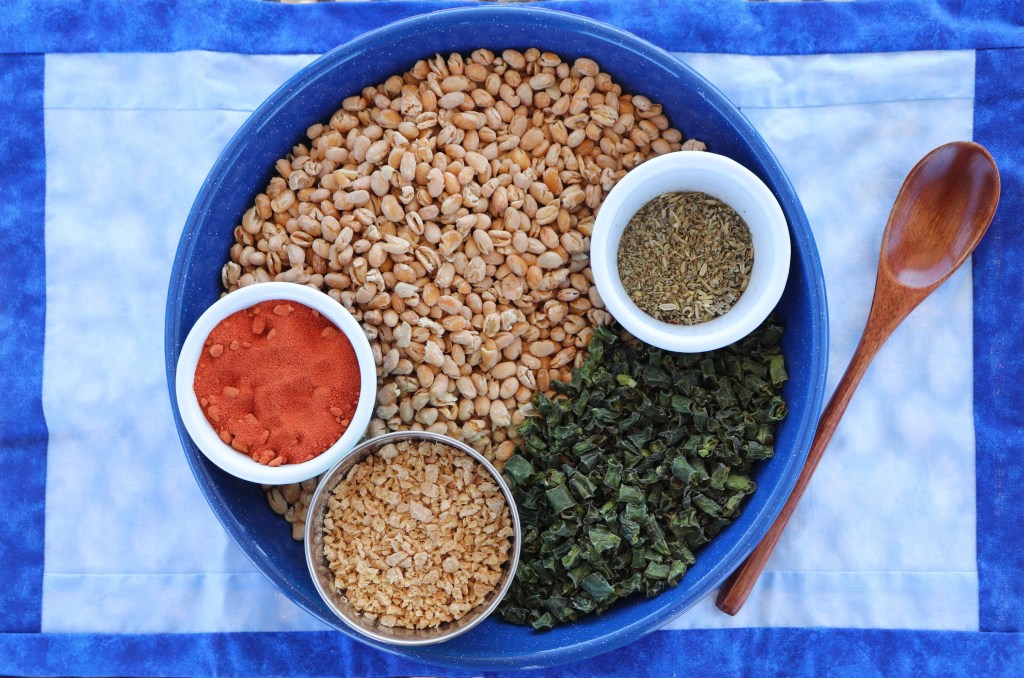
Photo shows a deep-dish blue plate on a matching blue placemat. Artfully arranged on the dish (::cough:)) are soup mix ingredients: navy and green beans, tomato powder, soy curls, and dried herbs and spices. To the side is one smallish wooden spoon, which is all the energy the assembly demands.

Advance planning: On a day when I have about half a spoon of spare energy (5 minutes to gather/put away ingredients, and 5 minutes to mix them), I make 6 servings of dry soup mix, with parboiled, dehydrated navy beans, dehydrated vegetables, and seasonings.

Zero spoon days: On a day I know will be exhausting, like my weekly travel and chore days, I add a serving of soup mix, olive oil, and boiling water to a thermos in the morning (zero spoons). On unexpected no-energy days I do the same at some point when I’m already up and about so I don’t waste energy making a special trip to the kitchen. At dinner time, when I most need some nutritious, hearty, comfort food, I have a delicious meal all ready to go (zero spoons).*

That is six zero-spoon meals, my friends, for half a spoon’s worth of energy in advance. That is a lot of flavor and nutrition bang for the effort buck. 

I wish I had even thought of the humble thermos when I was still working or had my house. Thermoses are portable—I could have eaten a hot (or cold) meal between exhausting errands or doctor’s appointments. They are lightweight—I would not have had to lug the slow-cooker around my kitchen. Their vacuum-sealed, not-quite-boiling, slow-cooking environment concentrates flavors, which means more taste for less effort. My thermos is small enough to open without hurting my hands on higher pain days.

And dehydrated veggies—well. They will get their own post, because they have been game changers for me. But for now, suffice it to say that they have 90% of the nutrition of their fresh counterparts with no chopping. As long as you don’t expect any preserved food to act or taste like fresh (do you expect vodka to taste like a potato??), you can play to their strengths, and zero-spoon soup mixes are one of dehydrated veggies’ very great strengths.

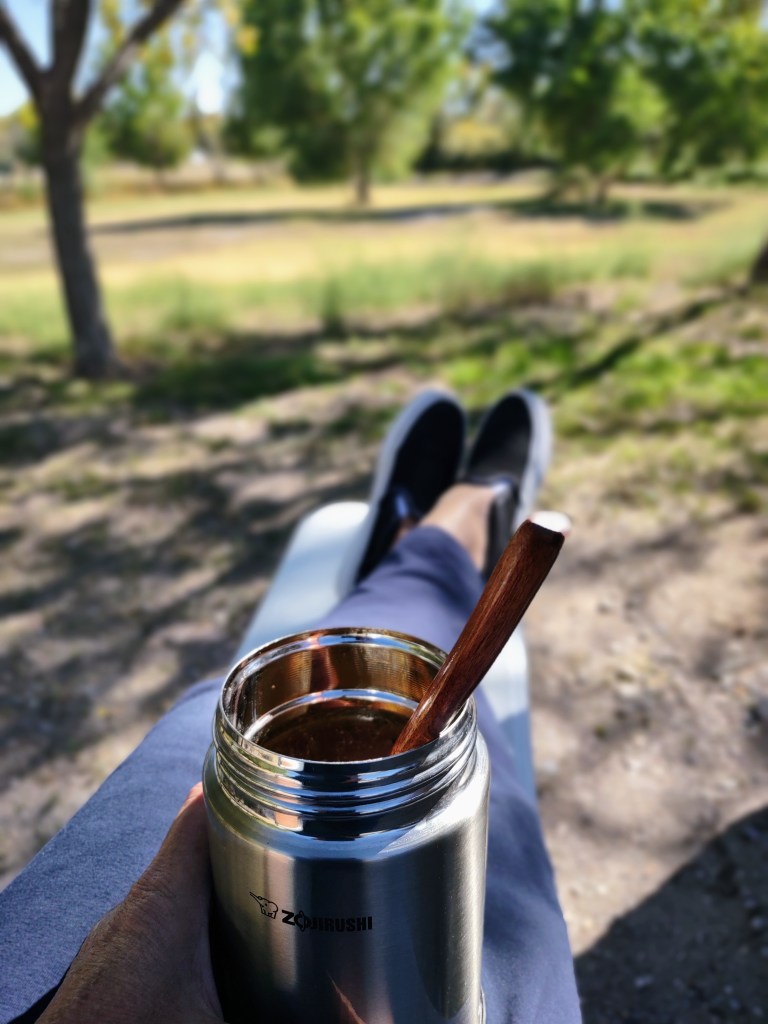
I’ve been told that proper food blogs feature photos of the plated dish, so here ya go: Image shows a hand holding a shiny, silver thermos with a spoon sticking out of it at a jaunty angle. The diner’s feet are elevated on a bench outdoors. (Could she possibly have POTS??) In the sunlit background, cottonwoods along the southern Rio Grande are just barely tinged with autumn gold.

I’ll share the recipe below as an example of proportions. So many of us have food sensitivities or special diets that recipes aren’t always much use among us. If the idea makes sense in your life, though, the recipe is here as a helpful framework for you to build on.

Tl;dr takeaways:

  • Prepare ahead for inevitable zero-spoon days.
  • Thermoses are lightweight, portable ways to cook hot zero-spoon foods.
  • Dehydrated veggies make great zero-spoon soups.

What about you? What is one simple, low-effort thing you can do this week to set yourself up for a nutritional win on your next zero-spoon day? How might you make it a habit?

__________________

*At dinner time I could also just put the soup mix, oil, and water in a pot on the stove for 15 minutes. Physically that would still be zero spoons, but it would cost a mental spoon because I’d have to find the gumption to take action.

Zero Spoon Day Navy Bean Soup

(Note of caution: I never actually measure anything, so these are all estimates. But they’re close enough to give you the idea.)

Per serving:

1/4 C parboiled, dehydrated navy beans

1 T unflavored soy curls/TVP flakes

1 heaping T dehydrated green beans

1 scant T dehydrated spinach

1 heaping tsp. tomato powder

½ tsp. Italian seasoning or to taste

½ tsp. fennel seed

¼ tsp. black pepper

Salt to taste

Put everything together in a zip-lock bag and shake to mix. Sometimes I also add 1 T dry packed, julienne sliced sun-dried tomatoes per serving.

To prepare: Add ingredients to a 16-oz. vacuum-seal food jar with about 1 T olive oil and boiling water to fill the jar. I usually add garlic powder and sometimes chives just prior to serving, as thermos lids absorb garlic and onion odors too, too well. Cost: roughly $2.50-3.00 per serving.

We Resume Our Irregularly Scheduled Programming

Why did I abandon this blog so soon after starting it? It didn’t happen consciously. It just presented challenges I struggled to resolve, and I followed the path of least resistance.

Here were the challenges:

  • The physical drain of taking quality photos was far greater than I expected. I could prepare a meal, or I could photograph it, but not both. Yet I felt photos were important. They convey a vital message that food can be the stuff of sensory delight. I was afraid the message of long blocks of text without photos would be “Food is all work with no play.” If you’re here, you may be hungry for the reminder that cooking can be beautiful.
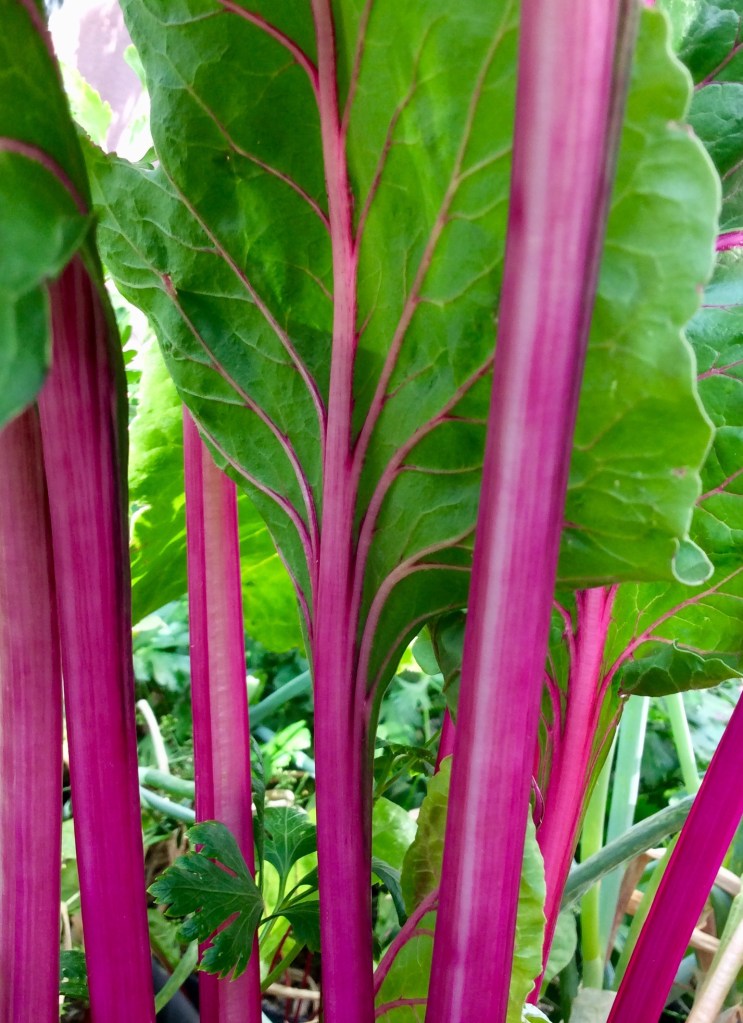
Image shows the vivid pink stems and spring green leaves of “Flamingo” chard growing in containers in my former garden.
  • My natural style of writing is daydreamy and explorational. It has metaphors and stuff. I don’t do nuts and bolts well or with pleasure. But I also have cognitive difficulties and recognize that for many of us, nuts and bolts are all the the bandwidth we can spare for reading—especially if we need practical strategies for preparing tonight’s dinner.
  • I felt like the overall list of strategies had said everything I had to say, and that anything further was belaboring the point.
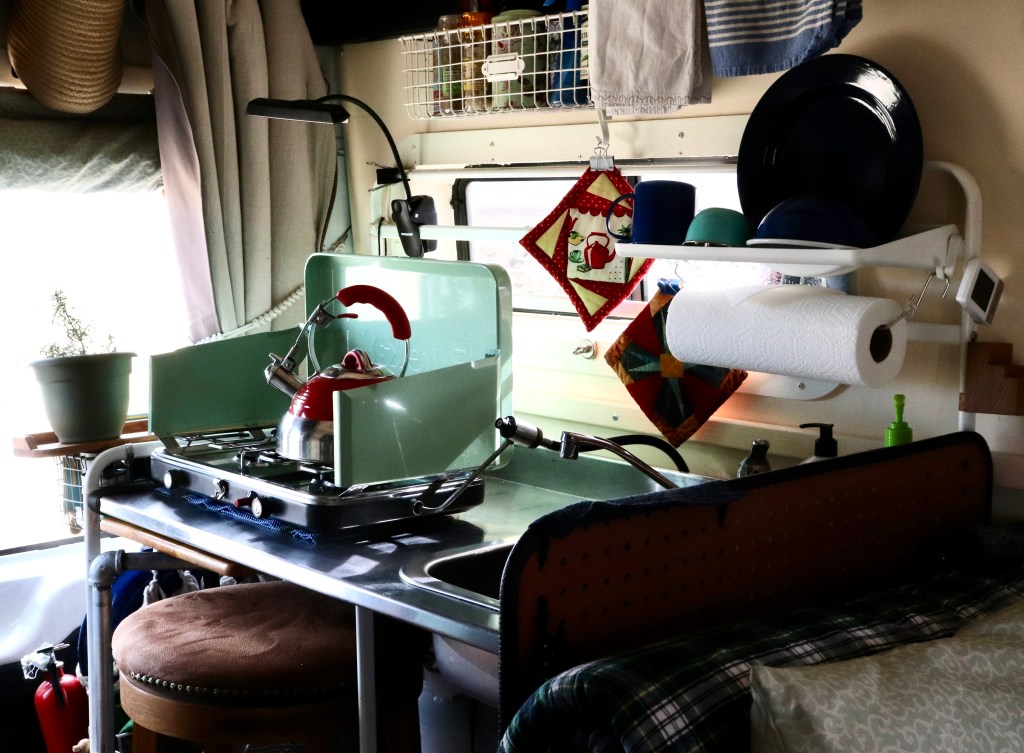
  • After years of being mostly housebound, I was losing my love for life. So a couple of years ago, I moved into a camper van conversion so I could move my house around (which is not something I recommend for everyone!) and fell in love with life again. But my awesome strategies became irrelevant. I have no oven, fridge (let alone freezer), or microwave—my mainstays. I have been learning how to cook in low-spoon ways in a whole other kind of kitchen, and I have been unsure whether any of my new finds would work for others.
Image shows my kitchen—a sink, camp stove with cheery red kettle, some shelving, and glory be, a knee-hole so I can actually sit to cook on a cushy swivel bar stool.

Then one of my dearest friends developed chronic pain and autoimmune illnesses. Her lifestyle and conditions (let alone her digestion) could not be more different than mine. Yet her need for nourishment is the same. We began talking about cooking and the lack of resources for people with chronic pain and illness. Not diet resources—this community is awash with specialty diet protocols—or recipe books but strategic ones: how to use your energy to its best advantage to nourish yourself Every. Single. Day. This blog has, we hope, the potential to be a much-needed resource.

Michele will occasionally become a voice here, talking about her much different needs, struggles, and insights. One Spoon Cooking will change in other ways, too. I will include photos of beautiful places I’ve had the pleasure of resting in (because going to beautiful places and lying down in them is how I do #vanlife), with the occasional snapshot of pretty ingredients if it’s not too much work. Strategic posts will be organized in an easily accessed Nuts and Bolts section. Some posts will be about searches for solutions, because as life changes new ones need to be found. Some will be about attitudes toward food and how they are currently shaping our quality of life. We’ll do some book reviews as they seem helpful. I’ll explore strategies I’ve discovered since being in the van that I wish I’d known about in my house.

Image shows a duck hopscotching across Antero Reservoir in Colorado in preparation for takeoff. Mist rises from the water below the snowy peaks of the Sawatch Range. View from my window, September, 2023.

If there’s something you’re missing, some strategy you crave, please tell us in the comments. We will pool our resources and see if we can help. Our aim is to put our experience to work for us all, but especially those who may be new to diagnosis and overwhelmed, or whose illnesses have suddenly changed direction.

If you are reading this after all these years, I thank you. I’ve learned that we have never said all we can about food. Our need for it never ends, and our need for inspiration and connection around it never ends. So in a toast to inspiration and connection, I raise my virtual spoon to yours. Let’s get cooking.