Knife Sharpening (Or: Carts and Horses)

In theory, this post is about sharpening knives. In reality, it’s about keeping cart and horse in the right order. Sometimes when we can’t do things the way we used to, we have to change our standards of “best practice.” The new, easier way can feel like “settling” when in fact it’s healthy adapting. For me, that feeling of settling is a red flag that I have lost sight of the real priority.

My dad is a whetstone sharpener. Watching him mesmerized me as a kid—Dad was always so relaxed, and I loved seeing his hands turning to hold the knife at the perfect angle, hearing that easy, rhythmic hiss of knife across stone, the ritual application of mineral oil and cleaning cloth. Whetstones, as YouTube (and my dad) will tell you, are the gold standard of knife sharpening.

Image shows a photo of Mom’s three wood-handled kitchen knives—wedding gifts. Near the heel, the blades are still their original shape, but they narrow right above, worn away by 67 years (and counting) of weekly sharpening. (Dad also made the card table they’re lying on.) Photo by Mom.

Dad taught me how to use a whetstone. But after I got sick I seldom did, and so spent a lot of unnecessary effort using dull knives instead. For me, it was the best or nothing. Then I discovered this:

Image shows a knife-sharpening gadget with a plastic handle and two slots with angled honing stones for coarse and fine sharpening.

Dad cringes at it. The poor man—it hurts him to see tools treated without love and care. There’s no ritual to it, no beauty or art. He fusses that I will damage the knives—a terrible crime. (I haven’t.) But the gadget is easy to use in just a few swipes, and my knives are always sharp. Are they sharp enough to slice a tomato paper thin? No. Do I need them to be? No. This is an easy device to use, so I use it. It’s not the gold standard whetstone cart, but I have the sharp knife horse.

To be clear, I’m not preaching the virtues of this gadget or any way of knife sharpening. I’m preaching the virtue of remembering what matters.

My sister is an avid photographer and owns some mighty fancy lenses, yet she always says that the best camera to use is the one you have in your hand. The best knife sharpener is the one you will use. The goal isn’t really to do things the “best” way. It’s to have sharp knives. And even sharp knives aren’t an end in themselves. They’re a means to help you nourish yourself as easily and as well as possible.

As long as we’re talking about knives… Image shows a black-and-white close-up of bayonet-sharp yucca leaves fringed with softer, curling fibers. Rockhound State Park, New Mexico

As I said, I’m using knife sharpening to illustrate a mindset that can plague us and keep us from adapting. Is there an area of your life where you’re clinging to a gold standard method purely because it’s the gold standard, even though it is now making your life harder? Where might you take a fresh look at carts and horses?

In Praise of Dried Vegetables

I recently promised (threatened?) to honor dehydrated vegetables in their very own post. Here are my impressions from a couple of years’ experiments.

Tl:dr: Dried veggies are great helps for cooks with energy-limiting or pain-causing conditions. They do have different flavors and textures than their fresh counterparts, though, so play to their strengths rather than expecting them to be equal substitutes.

The Upsides: Dehydrated vegetables have 90% of the nutrients of fresh. (They lose some heat-sensitive vitamins like C. If that’s a concern, look for freeze-dried veggies rather than dehydrated.) They require no chopping. They won’t spoil if you have a few rough days (or years…) in a row. They are “set it and forget it” foods that make pacing easier. They’re available online, so accessible to people who are housebound and/or living in fresh-food deserts. You can prepare meal mixes with them for zero-spoon days or travel. Solo cooks can easily make single servings.

The Neutral: Their flavor tends to be more intense than fresh, since all the diluting water is gone. To me that’s an asset, but you have to account for it—these foods have a learning curve.

The Downsides: They do have a learning curve if you want to make the most of them. Despite the claims of the companies that sell them, the flavors and textures of reconstituted dried veggies are not the same as fresh, frozen, or canned, and you may well notice that and not like it if you swap them straight out. Yet recipes tailored for them are thin on the ground. In addition, dehydrated vegetables cost more than fresh, unless you dehydrate your own. They generally don’t shine solo, which narrows their usefulness.

Recommended Uses: Dehydrated veggies make superb soups or additions to stews, grain and legume cooking liquids, casseroles, and some sauces. They give their best with low-and-slow cooking methods, as the veggies’ stronger flavors infuse the cooking liquid to make a rich broth. Use smaller quantities than of fresh so the flavors aren’t overpowering. Err on the side of caution until you know what you like.

While their flavors are stronger, dried veggies are missing some living brightness. After a few meals they begin to pall. Adding just one fresh ingredient to a dish—anything from a garlic clove to a single carrot or diced tomato—can restore their zing.

As I said, they are not direct substitutes for their fresh counterparts! Sun-dried tomatoes will never give the juicy-crisp texture of a fresh beefsteak tomato to a BLT. Play to dried vegetables’ strengths and honor what they can do. Texture is often not their strength; flavor usually is, but that flavor has different “notes” than fresh.

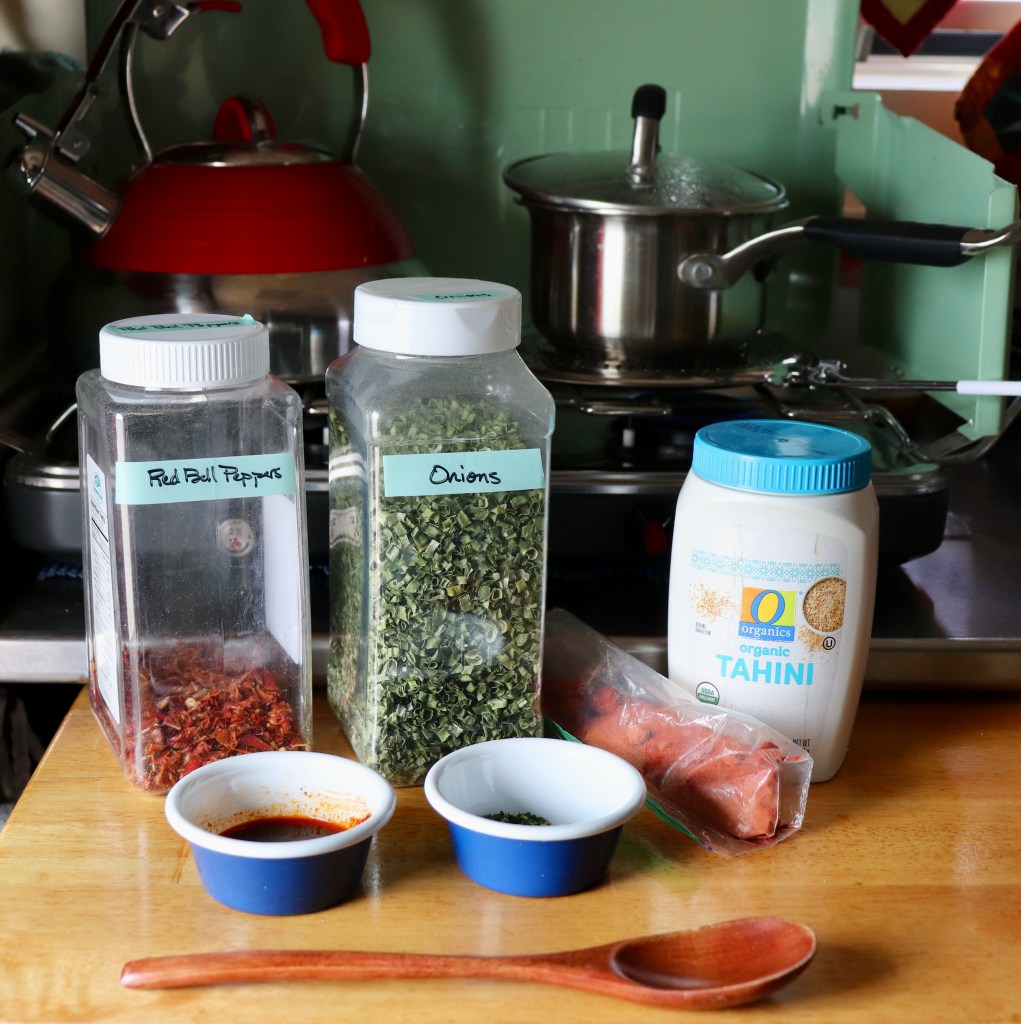
Image shows meal preparation in progress: In the background, a pot of toasted red lentils simmers on a flame tamer. In the middle ground are containers of dried red bell peppers, chives, tomato powder, and tahini. In small dishes in the foreground are New Mexico red chile oil (toasted earlier, directly in the dish, while I waited for my morning tea to brew) and dried spinach. Toasting the lentils and chiles gives the stew the liveliness it might otherwise lack. I will put a spoonful of each ingredient in the pot and let everything cook sloooowly, and maybe add a teeny splash of vinegar at the end. Energy cost: One spoon.

Recommended Veggies (in no particular order)

  • Julienned, dry-packed, sun-dried tomatoes. Intense flavor on the sweet-tart side. These can usually be used either straight from the packet or reconstituted. They’re good additions to whole grain bowls, pastas, or bean salads. I often chop them more finely to distribute them better through the dish. Recipes abound for these, as they were the It ingredient about 20 years ago.
  • Tomato powder. One of my favorite ingredients of all time—it is So. Useful. Combine equal parts powder and water to make tomato paste. Add a teaspoon or so of powder per serving to many soups for richness, or two or more to make it tomato-based. (But don’t use just tomato powder to make tomato soup. It will be Sad.) Mix a small amount into a plain vinaigrette for a little sweetness. I add a sprinkle while sautéing sweet bell peppers if the peppers are bland. As with all dehydrated veggies, err on the side of caution until you know what you like—you can always add more. Too much tastes metallic to me. Tomato powder cakes easily when exposed to air, so I recommend storing it in a zip-lock bag or something that lets you squeeze the air out of the package.
  • Chopped spinach. A great “stealth” vegetable in soups. Start with a scant tablespoon per serving. More than that, and it is no longer stealthy—the cooked spinach flavor is pronounced.
  • Celery. Dried celery tastes like CELERY—ultra-bright and grassy, with a hint of salt. If my taste buds need entertained, I snack on this straight from the package, when the texture is crunchy-chewy. Use it sparingly in soups, as it will not stay politely in the background, and the texture turns rubbery.
  • Powdered porcini mushrooms. These have typical porcini mushroom flavor, amped up by 10. (Store the opened powder in a glass jar with an airtight lid, or your whole cupboard will smell like mushrooms x 10.) Stir a teaspoon into cooking liquid to make a rich broth. Sprinkle a tiny amount anywhere you want to boost savory, umami flavors. My current favorite: Soak 2 generous tsp. mushroom powder, 1/2 C cashews, and other seasonings to taste in 1/2 C boiling water until the cashews have softened. Blend to make mushroom gravy or cheater’s stroganoff. Delicious on egg noodles or buttered whole grain toast.
  • Chopped green beans. Excellent in soup. These are the only dried veggie I’ve tried that I would eat as a regular side dish—they make me nostalgic for childhood. They taste like livelier versions of canned beans.
  • Chopped chives. I prefer these to dried onions in soups, etc. To my palate, dried onions are more sulfur-y.
  • Red bell peppers. I actually prefer cooking with these than with fresh, as they’re more intensely sweet with a hint of paprika’s depth of flavor. They’re fabulous additions to black bean anything, chili, and sauces. I also like to reconstitute them in water and olive oil with some Italian seasoning, garlic powder, and the like, then add a splash of vinegar to make a sauce, spread, or dip. I recommend waiting to add vinegar to any dried vegetables until they’re almost fully reconstituted, as the veggies absorb too much otherwise.
  • Freeze-dried corn. This is good in soup or chili and reconstitutes fairly well as a plain side dish. I also like sprinkling it dried on salads as a crispy topping . When reconstituted it is similar to frozen corn in flavor and texture.

Neutral (Neither recommended nor not recommended)

  • Dried whole mushrooms. Like the powdered ones, they offer delicious, intense mushroom flavor, and they come in more varieties. They tend to be gritty, though, even if you soak and rinse them. (And if you discard the soaking water, you’ve discarded a ton of flavor.) Chopping the mushrooms prior to cooking can offset their rubbery texture. A little goes a long way: one shiitake mushroom can easily flavor a serving of rice.
  • Heat-dehydrated corn. The flavor is a little like hominy, and the texture is chewy in a good way. I enjoyed it, but it is sloooowww to reconstitute.
  • Carrots. I like the flavor (though it’s tinny in excess) but don’t care for the rubbery texture. Your mileage may vary—many people love these.
  • Sweet potatoes. I always keep them on hand and have tried them successfully in soup and chili, but I more often find an excuse not to use them. I suspect they have potential that I don’t know how to bring out.
  • Green bell peppers. They’re not my favorite fresh vegetable, so I disliked the strong flavor of dried. If you like them fresh, you may enjoy these.

Not recommended

  • Broccoli. I liked the taste—a little like roasted broccoli. But I got a lot of inedible, sharply fibrous stalks mixed in with the florets—maybe 25%. Too much unpleasantness for the reward. If you can find 100% florets or dehydrate your own, go for it.
  • Leeks. Exceptions to the “intensified flavor” rule. The ones I tried had very little flavor.

Not tried: Butternut squash, zucchini, cabbage, and I don’t know what else.

Goodness, you’ve been reading a lot of prose. Image shows a juniper trunk and branches in silhouette framing a sliver of lake, a mesa, and a glowing evening sky. View from my sliding door, Heron Lake State Park, New Mexico, September 2023

Honorable Mentions (They’re not technically vegetables, but still useful)

  • Pinto or black bean flakes. (These are often marketed as “instant refried beans,” though they take 10+ minutes to reconstitute.) Depending on how much hot water you add, they can be dip, soup, or a soup thickener. I prefer the ones with added salt only, but you can also get them pre-seasoned with Tex-Mex type flavors.
  • Instant mashed potatoes. One tablespoon can quickly thicken a thin soup. My favorite instant comfort food mix: potatoes, powdered milk, Parmesan cheese, dried chives, dill, garlic powder, salt, and pepper. Combine one serving potato mix with hot water and a pat (or two) of butter. Ready to eat in 60 seconds tops.
  • Unflavored soy curls/TVP. These add quick protein to soup or whole grains and can be seasoned however you like. I don’t recommend the chicken or beef flavored ones, as they don’t taste particularly like chicken or beef. A better option is to use, say, chorizo or sausage seasoning blends to flavor the cooking liquid.

Brands: I only have experience with brands available in the USA. Augason Farms have been the most consistently good. They have a broad range of choices in No. 10 cans. It’s Delish products have had excellent flavor for good value, though they have limited choices. Frontier Co-op, Mother Earth Products, and Bob’s Red Mill are good sources for dried legumes and TVP. I give Harmony House mixed reviews on quality, but their sampler packs are helpful. Their spinach, green beans, celery, and tomato powder have been good.

What am I missing? Have you tried other dehydrated vegetables? Can you recommend other ways of preparing them?

Book Review: The Lazy Genius Kitchen

The Lazy Genius Kitchen: Have What You Need, Use What You Have, and Enjoy It Like Never Before by Kendra Adachi

Tl;dr: I highly recommend this book. It is the most useful I’ve read in 27 years for managing the ups and downs of energy-limiting chronic illness, because it is not a “system.” It’s a set of thought processes designed to help you where you are right now.

Who this book is for: The Lazy Genius Kitchen is probably primarily useful for people whose abilities or lifestyle have recently changed, and whose old routines aren’t working; new cooks; and people who have lost their “groove” in the kitchen.

Why I read it: I had been at a stuck place with my meals—they were nutritious and easy (i.e., I would just eat raw spinach or whole grain bread straight from the package) but didn’t satisfy me (huh). But cooking routines failed me as my symptoms waxed and waned and I adjusted to my van.

The LGK appealed to me because its focus is on thought processes and strategies rather than recipes or systems. It helped me identify problems and steered me toward solutions that worked for my body, lifestyle, and tastes.

Overview: Adachi separates all aspects of meals into six categories:

  • Space (Your kitchen, including tools)
  • Meals (The general kinds of things you make and eat)
  • Menu Planning (How you narrow those generalities into daily food choices)
  • Food (subdivided into Groceries, Shopping, and Storage)
  • Prep (How you get into and maintain a work flow)
  • Gathering (What the “table” means for you)

For each category, you go through the following steps:

  • Prioritize: Identify the top three priorities for your current season of life and name the #1 priority (Adachi offers a list of starting suggestions)
  • Essentialize—Get rid of anything in the way of the #1 priority
  • Organize—Put everything that remains in its place
  • Personalize—Figure out what makes you feel at home, keeping in mind your personality, people, priorities, proficiency, process, pleasure, and peace
  • Systematize—Find ways to stay in the flow

What worked for me: A) Thinking of each category separately rather than lumping things like “Meals” and “Menu Planning” together; and B) identifying my #1 priority in each.

(The rest of this section shows examples of how I am putting the LGK into practice. Skip it if it’s TMI.)

For example, I had been thinking of “meals” in a way that lumped them together mentally with menu planning, groceries, shopping, and preparation. The menu/meals dictated everything else. If I hit a snag in one area—if I couldn’t find go-to ingredients (Groceries) or get curbside pickup (Shopping), or I didn’t have energy (Prep) to make my planned Menus—my meals suffered.

Additionally, I had multiple priorities that were all good—nutritious, affordable, tasty, and easy—but they sometimes came into conflict. On a weary day, when my body needed both rest and food NOW, I had no “good” choice that did not also cause harm. That created no-win scenarios and extra stress.

The LGK helped me separate “meals” into all those distinct components with capital letters. Going through the 5-step thought process for each of them led me to more tailored strategies.

Now my top priority for Groceries is that they are nutritious—I (mostly…) buy food that is healthful, so every meal, no matter how simple or complex, will tick that box. I Shop more online and in bulk to be sure I have access to those foods. My priority for Menu Planning is flexibility, which means I have some flavor combinations in mind that work equally well with minimal preparation or more effort. My priority for Prep is good pacing. I systematize that by focusing on thermos soup mixes or flavor boosters like spice blends, dressings, or toasted nuts I can make in advance, so that even a simple bowl of grains and greens (or instant mashed potatoes) can be dressed up.

Where I used to have four priorities for meals, which conflated all those categories and would sometimes leave me in a bind, now my top priority for Meals is simply that they make me feel cared for. If that means making a three-course meal, great! I can do it. If it means doing something easy so I can rest, great! I’ve taken steps in other areas to ensure that the easy food is nutritious and tasty.

Other things that might help people with energy limits:

The section on Space might be extra helpful to those who have been newly diagnosed or whose abilities have recently changed. We can get so used to our kitchens that we don’t notice when they become obstacle courses. This section might give you fresh eyes to see where your space could serve you better. (The Essentializing step in all 6 categories might also be extra helpful.)

Adachi suggests keeping a written list of “Plan B” menus readily at hand—fail-safe, no-effort things you can turn to when you’re wiped out. For me, this is truly genius, because you know what else I can’t do when I’m wiped out? Remember my fail-safe, no-effort go-to’s.

The Gathering category and Personalizing step (in all the categories) were unexpectedly moving to me. Many of us have to change our diets or methods in ways that feel alien to us when we become ill—when our very bodies might feel alien to us—and LGKs focus on feeling at home hit the spot.

The final section gives a quick and dirty guide to basic cooking techniques, including some classic flavor combinations, flavor boosters, temperatures for roasting vegetables, and the like. If cooking off-recipe would help you with pacing, this section might be a useful jumping-off point for improvising, especially since the information is all in one place.

The Master List of Salad Ingredients is actually a great grocery/pantry template for low-energy cooks all by itself: mix-and-match ingredients that can jumpstart hot or cold meals with little effort. (Not all of the ingredients will work for specialty diets, of course, but this kind of template can be more spoon-friendly than recipes.) The Liquid Index Ingredient Guide is similar—a way of creating flexible meal plans that adapt to varying energy levels.

Adachi encourages being realistic about what can be done in different “seasons of life.” That’s wholesome advice in general, but even more so when your season has changed without your consent.

This may be a book about kitchens and meals, but the five steps can clarify and simplify other life tasks as well. One of the odd gifts of chronic illness is that it encourages you to shed lower priority activities and things. LGK is a good roadmap to that end.

Some downsides/suggestions:

The Lazy Genius Kitchen is a follow-up to Adachi’s first book, The Lazy Genius Way. She summarizes the original book’s principles well and clearly at the beginning. It might not hurt to bookmark those pages, because she refers to the principles often, with a shorthand that’s clear on a good brain day but wasn’t (for me) on a brain fog day.

Adachi restates the five processes in every chapter. I liked that—it’s good “rehearsal.” Just be aware that a lot of material will come around again.

Adachi makes great claims for her Liquid Index and chicken recipe. They might be “life-changing” for you, or, erm, they might not. Don’t build too many hopes on them.

Adachi’s persona is very much the chatty BFF. Her informality makes the book an easy read even on brain fog days, but the chummy style might not be everyone’s cup of tea.

A note on the word “crazy”: Adachi uses it often, to mean “intensely frazzled.” She’s not alone—it’s a cultural norm. It breaks my heart when the life-fracturing reality of mental illness is minimized or made comical. I would love to see that norm change.

In sum:

The strength of this book for people with chronic physical illness is that its processes are adaptive. As Adachi writes, “They are foundational to finding pain points, naming helpful solutions, and creating a sustainable rhythm in your kitchen for as long as you have one.” Our capacities can vary hugely from day to day, so rigid diets, routines, and systems tend to fail us: they require us to adapt to them. Adachi’s steps help our kitchens adapt to us.

“A sustainable rhythm in your kitchen for as long as you have one…” One of the most beautiful things about The Lazy Genius Kitchen is that Adachi doesn’t assume everyone reading it is now and will be forever able-bodied. She just assumes you’re…human and will change. That alone makes it a rare gem.

__________

I didn’t receive anything for this review, and the link isn’t an affiliate link. I just think The Lazy Genius Kitchen is an excellent resource.